
Stop forgetting vocabulary. Start actually learning it.
If you’ve ever spent months studying a language only to blank on basic words mid-conversation, you’re not failing — you’re using the wrong method. Rote repetition and word lists don’t stick. Science does.
Whether you’re cramming before a trip to Puerto Rico, picking up Spanish for work, or just frustrated that nothing seems to hold, this post lays out a strategy grounded in how memory actually works: the right words, in the right order, reviewed at exactly the right time.
I also built a free offline app called TopWords that implements all of it — no subscriptions, no ads, no account. I’ll cover it in detail below. If you want the companion quick-reference of common travel phrases first, that’s here: Essential Spanish Phrases.
1. The 80/20 Rule: Why Phrasebooks Are Holding You Back
You’ve probably heard that the top 1,000 most common Spanish words cover about 80% of everyday conversation. That’s a great hook — but it undersells the actual opportunity.
Paul Nation’s lexical frequency research shows that the top 2,000 word families provide roughly 97% lexical coverage of everyday spoken discourse. At that point, you can carry a real conversation, infer unknown words from context, and start building fluency at a natural pace.
Phrasebooks can’t get you there, and here’s why: they give you lexical breadth — a surface-level exposure to many phrases — but zero lexical depth. When someone responds to your scripted “¿Dónde está el baño?” with a fast string of natural Spanish, the phrasebook gives out. You haven’t learned how Spanish works; you’ve memorized a few shortcuts.
Lexical depth means understanding how a word behaves in context — what it collocates with, how it shifts meaning, when native speakers actually use it. That’s what frequency-based vocabulary learning builds, and it’s what phrasebooks skip entirely.
The takeaway: spending your time on the top 2,000 most common Spanish words is not a shortcut. It’s the most direct path to real comprehension.
2. Essential High-Frequency Spanish Categories (and the Infinite Loop Hack)
Most Spanish learning resources bury you in conjugation tables before you can say anything useful. There’s a better entry point: anchor modals.
The Infinite Loop Hack
Three high-frequency verbs unlock nearly every need you’ll have as a beginner:
| Anchor Modal | Meaning | Example |
|---|---|---|
| Quiero | I want | Quiero un café — I want a coffee |
| Necesito | I need | Necesito ayuda — I need help |
| Voy a | I’m going to | Voy a tomar el autobús — I’m going to take the bus |
The hack: pair any of these with an infinitive verb and you can express almost any intention without touching a conjugation table. [Quiero / Necesito / Voy a] + [infinitive] is a productive sentence every time. This isn’t a cheat — it’s how beginners naturally start speaking in every well-researched language program.
Cognate Exploitation: You Already Know Hundreds of Spanish Words
English speakers have a hidden advantage almost no one mentions. Spanish and English share thousands of cognates — words with the same Latin root. Many follow predictable patterns:
- English -tion → Spanish -ción (information → información, communication → comunicación)
- English -ty → Spanish -dad (university → universidad, liberty → libertad)
- English -ous → Spanish -oso/a (famous → famoso, delicious → delicioso)
When you recognize a pattern like this for the first time, it’s a genuine psychological win. You realize you’re not starting from zero — you have a foundation to build on immediately.
3. The Retention Problem: Why You Keep Forgetting What You Study
Here’s something frustrating that every language learner hits: you study a list of Spanish words one evening, feel confident, and then completely blank on half of them two days later.
This isn’t a you problem. It’s a memory problem, and it has a name: the forgetting curve.
Hermann Ebbinghaus mapped it in the 1880s and it still holds up: without reinforcement, humans forget roughly 50% of new information within a day, and up to 90% within a week. The traditional response — just re-read your notes — doesn’t work because passive re-exposure barely slows the decay.
How Spaced Repetition Fixes It
The solution is spaced repetition — specifically the SuperMemo SM-2 algorithm, the same method researchers and polyglots have relied on for decades, and the foundation TopWords is built on. Here’s how it works:
Every word you study gets its own personal review schedule. Nail a word? It comes back later. Struggle with it? It comes back sooner. Over time, the app maps your memory and fills the gaps automatically — not by shuffling a deck, but by calculating the exact day you’re about to forget a word and scheduling a review right before that happens.
The modern implementation of this idea is FSRS (Free Spaced Repetition Scheduler), a data-driven successor to SM-2 trained on millions of real flashcard reviews. It models your retention rate and memory stability per word, so every review lands at the highest-leverage moment in your forgetting curve. You review less but remember more.
4. TopWords: Study Only What Matters
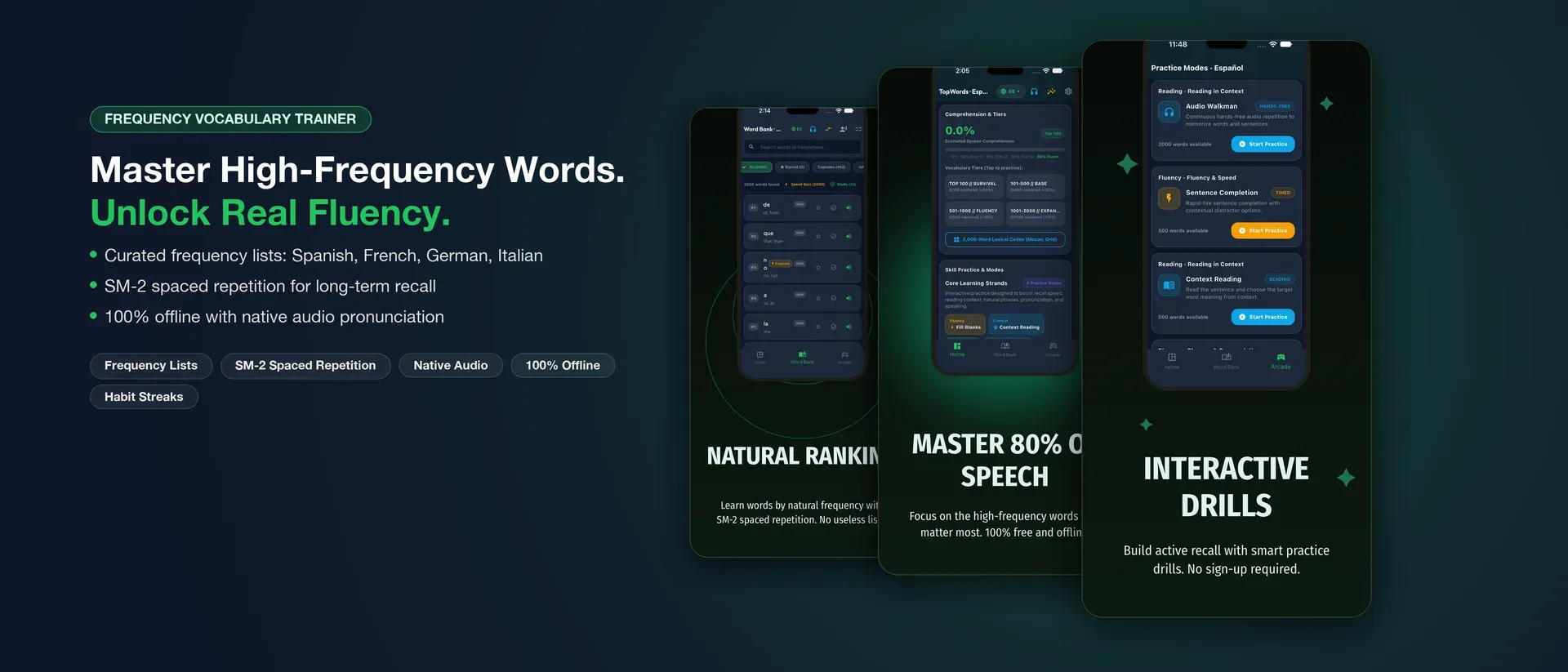
TopWords is a free mobile app built around one idea: learn the words that matter most, in the order your brain is ready to absorb them.
I built it because I wanted to get conversational in Spanish without spending months on beginner filler. Everything in the app comes back to that principle.
Frequency-First Curriculum
TopWords ships with high-frequency vocabulary — the words you’ll actually hear and use, not obscure filler to pad a word count. Words are ranked by real-world usage frequency across natural speech and text corpora. Word #1 is the most common word in Spanish. Word #2000 is still more useful than 99% of what a traditional curriculum would put in front of you in the first month.
Each entry includes the word, its translation, part of speech, and an example sentence so you understand usage, not just definitions.
Audio Pronunciation
Tap any word to hear it spoken aloud in native-quality text-to-speech. For getting the accent right — or working with languages that have unfamiliar sounds — hearing it matters as much as seeing it.
Cognitive Load and UI Design
One of the most underrated factors in language learning is extraneous cognitive load — the mental effort spent navigating the interface rather than learning the content. Cluttered apps with badges, progress dashboards, and gamification mechanics pull your working memory away from the actual words.
TopWords presents one atomic flashcard at a time. Nothing competes for your attention. Your brain’s encoding resources go entirely toward the word in front of you.
Smarter Wrong Answers
Most vocabulary apps generate random wrong answers. If the correct answer is hablar (to speak), you might see comer (to eat), dormir (to sleep), and correr (to run) as distractors — obvious enough that you can answer correctly without actually knowing the word.
TopWords uses AI-generated, semantically optimized distractors — wrong answers that are contextually plausible near-neighbors of the correct answer. This forces genuine comprehension rather than process-of-elimination guessing. Your brain has to actually retrieve the right meaning, not just rule out obviously wrong options.
Daily Goals, Streaks, and Progress
Set a daily goal, build a streak, and watch the stats compound. The home screen shows your progress at a glance: words mastered, reviews due, and how close you are to today’s target. At a consistent pace of 10 new words per day — achievable in a 10–15 minute session — you’d cover 1,000 words in about 100 days, and 2,000 in roughly six months.
60+ Languages. Zero Gatekeeping.
Spanish, French, German, Japanese, Arabic, Korean, Russian, Hindi, Chinese (Simplified and Traditional), and more than fifty others — including less common options like Basque, Esperanto, Georgian, Tagalog, and Icelandic. Switch any time. Your progress for each language is tracked independently.
Why Free? Why No Backend?
Most vocabulary apps monetize by locking content, selling streaks, or mining usage data. TopWords does none of that. The app is fully offline, fully local. Your vocabulary progress, your streak, your data — none of it touches a server. No subscriptions. No ads. No account. Everything lives on your device.
This isn’t just a privacy feature — it means the app works on a plane, in a remote village, or anywhere you don’t have signal.
Download TopWords free:


Or try the Web App right now, no install required.
5. Frequently Asked Questions
Who is TopWords for?
- Students cramming before a trip or an exam
- Language learners frustrated with apps that feel like games but don’t teach
- Polyglots maintaining multiple languages at once
- Anyone who’s tried flashcards and wanted something smarter
Why use TopWords over Duolingo?
Paul Nation’s Four Strands framework is a useful lens here. Effective language learning requires four balanced activities: meaning-focused input (reading and listening to comprehensible content), meaning-focused output (speaking and writing), language-focused learning (deliberate vocabulary and grammar study), and fluency development (practicing at natural speed with known material).
Many gamified apps concentrate almost entirely on translation tapping — a narrow slice of the third strand — while neglecting output and fluency development entirely. The result is users who can earn points but can’t hold a real conversation.
TopWords is built for high-efficiency vocabulary acquisition (strand three), and it pairs naturally with the other three strands. Use it alongside conversation practice and Spanish content — shows, podcasts, books — and you’re covering all four.
Is there a difference between SM-2 and FSRS?
Yes. SM-2 (the SuperMemo-2 algorithm, developed in 1987) was groundbreaking and still works well. FSRS is a modern, data-driven successor trained on millions of real flashcard reviews. The key improvement is in how it models memory stability — FSRS more precisely estimates how long a memory will last before it needs reinforcement, which translates to fewer unnecessary reviews and better long-term retention.
Does TopWords require an internet connection?
No. Everything — word banks, your progress, review schedules, and audio — lives on your device. The app was designed offline-first from day one.
Can I use TopWords for languages other than Spanish?
Yes. TopWords supports 60+ languages, including Spanish, French, German, Japanese, Arabic, Korean, Russian, Hindi, Chinese (Simplified and Traditional), and many others — all using real-world frequency corpora for evidence-based word ranking.
Putting It Together
The most effective path to conversational Spanish:
- Start with anchors — internalize
Quiero,Necesito, andVoy aand you can communicate real needs on day one. - Mine cognates — identify the -tion/-ción pattern and other predictable bridges to build confidence fast.
- Study frequency, not phrasebooks — target the top 2,000 word families for near-complete everyday coverage.
- Use spaced repetition — let SM-2 or FSRS schedule reviews at the exact moment your memory needs reinforcement.
- Keep it consistent — 10–15 minutes daily beats weekend cram sessions every time.
Download TopWords free. Pick a language. Study five minutes. The algorithm handles the rest.
For the essential travel phrases themselves — greetings, dining, directions, and emergencies — check out the companion post: Essential Spanish Phrases.
¡Buena suerte!



Leave a comment